
Historical Background and Purpose of the Book.
The following book description was created with the help of the AI tool ChatGPT. (Used on 8/29/2026).
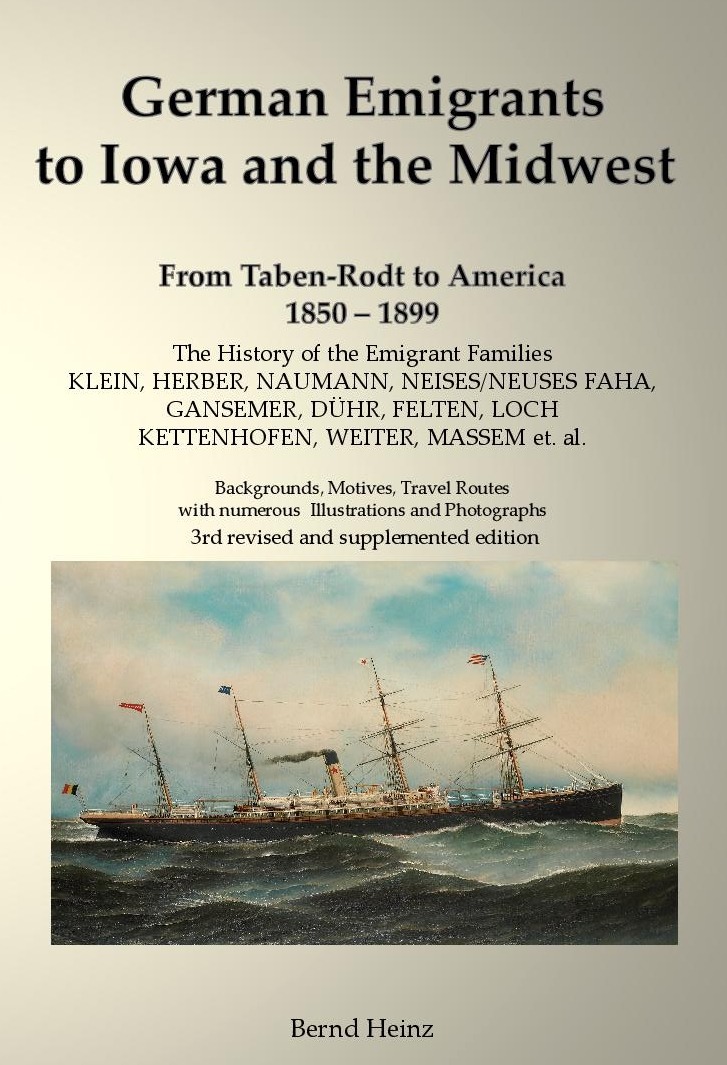
Scientific Summary of German Emigrants to Iowa and the Midwest
German Emigrants to Iowa and the Midwest by Bernd Heinz is a genealogical and local-historical study of German emigration from the communities of Taben, Rodt and Hamm, today forming part of Taben-Rodt in the Saarland region of Germany. The English-language third edition was completed in 2024 and was translated by Ben Weber in the United States. According to the author, the translation also included a review of dates and family relationships.
The study focuses primarily on the period from approximately 1850 to 1899, although individual migration histories begin earlier and extend well into later generations. Its central objective is to reconstruct the lives of emigrants from Taben-Rodt who left their European homeland during the nineteenth century and established new lives in North America, particularly in Iowa and the American Midwest.
The book places this local migration within the much larger nineteenth-century movement of Germans to the United States. According to the book, Germans represented one of the largest immigrant groups in the United States and were particularly numerous in Iowa, Illinois and neighboring Midwestern states. The emigrants from Taben, Rodt and Hamm therefore formed part of a broader transatlantic migration process rather than an isolated local phenomenon.
Causes of Emigration
One of the principal themes of the study is the socioeconomic situation in Taben during the nineteenth century. The book examines:
- agricultural development;
- commercial and economic conditions;
- wages;
- population growth;
- the costs of emigration;
- and the economic prospects available to ordinary families.
The author identifies poverty, limited economic opportunities and strong population growth as important factors encouraging emigration. During a period of approximately fifty years, more than 100 inhabitants of Taben, Rodt and Hamm—around one fifth of the population at that time, according to the author’s calculations—left for North America.
The decision to emigrate was therefore not simply an individual adventure. The book presents it as a response to economic and demographic pressures and as an attempt to obtain land, employment, greater economic security and a better future for the family.
The Migration Process
A major strength of the book is that it does not treat emigration merely as a change of residence. It reconstructs the migration process in several stages:
- departure from Taben, Rodt or Hamm;
- travel to a European seaport;
- the Atlantic crossing;
- immigration procedures in North America;
- the onward journey into the interior of the United States;
- settlement and acquisition of land;
- economic development;
- formation of new families and communities;
- development of subsequent generations.
The book therefore combines local history, migration history and genealogy. Passenger lists, U.S. and Canadian census records, historical maps, family documents, wills, gravestones and information supplied by descendants are among the sources used to reconstruct individual biographies.
Why Iowa?
Iowa occupies a particularly important position in the study. A large proportion of the emigrants from Taben-Rodt did not remain in the major coastal immigrant centers but moved into the developing agricultural regions of the American Midwest.
The principal settlement area was northeastern Iowa, particularly the region surrounding Dubuque. The book documents settlements in Dubuque County and Peru Township, as well as in communities such as Sherrill, Balltown and Dyersville. Other destinations mentioned include Jefferson Township, Buena Vista, Osceola and Camp Springs.
The attraction of Iowa was closely connected with the availability of agricultural land and the possibilities for establishing independent farms and businesses. The emigrants from the Saar region consequently became part of the transformation of the Midwestern frontier into a landscape of farms, villages, churches, businesses and family settlements.
The migration was not restricted to Iowa. Some individuals and families subsequently moved to Illinois, Wisconsin, South Dakota, Minnesota and other parts of North America, while the book also records connections with Canada.
Important Settlement Locations
The principal places associated with the emigrants documented in the book include:
Iowa
- Dubuque
- Dubuque County
- Peru Township
- Jefferson Township
- Sherrill
- Balltown
- Dyersville
- New Vienna
- Gilbertville
- Holy Cross
- Camp Springs
- Buena Vista
- Osceola
Other Midwestern destinations
- Wisconsin, particularly Brown County and Milwaukee
- Illinois
- Minnesota
- South Dakota
The settlement pattern demonstrates that migration was often a process rather than a single event. Families could initially settle in one locality and later move to another as they acquired land, established businesses, married or sought new economic opportunities. Individual family histories therefore provide evidence of considerable geographical mobility within the United States.
The Principal Emigrant Families
The book concentrates on a number of interconnected families originating from Taben, Rodt and Hamm. The principal surnames are:
- Klein
- Herber
- Naumann / Nauman
- Neises / Neuses / Neusius
- Faha
- Gansemer
- Dühr / Duhr / Duehr
- Felten
- Loch / Lash
- Kettenhofen / Kettenhoven
- Weiter
- Massem
The different spellings are historically significant. German immigrant surnames were frequently recorded differently in German and American documents, and the book consequently preserves variant forms of names such as Neises/Neuses, Dühr/Duehr, Naumann/Nauman and Kettenhofen/Kettenhoven.
Examples of Documented Individuals
One of the book’s important characteristics is its concentration on identifiable individuals rather than anonymous migration statistics.
Johann / John Klein
Johann (John) Klein, born on 30 November 1820 in Taben, emigrated in 1853 with his wife Catharina (Catherine) Herber, born in Rodt in 1828. Their destination was Peru Township in Dubuque County, Iowa. The family subsequently became associated with Sherrill.
The book follows the family over several generations, including descendants such as Peter Klein, John Georg Klein, Matthias Klein and Catharina Klein. A family reunion of Klein descendants in Cuba City, Wisconsin, in 2000 is also documented.
Peter Herber
Peter Herber, born in Rodt in 1835, emigrated as a young man and settled in the Sherrill/Peru Township area of Iowa. His later life and his marriage to Mary Reinert are reconstructed in the book, together with information about his descendants and gravestones.
Matthias Naumann
Matthias Naumann, born in Hamm in 1822, emigrated in 1853 with his wife Magdalena Leinenweber. Their family settled in Peru Township, Dubuque County. The study subsequently follows their children, including Magdalena, Peter and John Naumann, into the next generation.
Matthias Neuses / Neises
The Neuses/Neises family occupies a substantial section of the book. Among the documented individuals are:
- Peter Neuses, born 1832 in Hamm;
- Matthias Neises, born 1827 in Hamm;
- Jacob Neuses, born 1845 in Taben;
- Matthias Neuses, born 1842 in Taben;
- Franz Neuses, born 1834 in Taben;
- Peter Neises, born 1842 in Rodt.
Their histories include settlement, land ownership, wills, descendants and movements within the United States.
The Faha Family
The Faha family represents another important migration network. The book discusses:
- Matthias Faha, born 1840 in Rodt;
- Franz / Frank Faha, born 1843 in Rodt;
- Nikolaus Faha, born 1856 in Rodt;
- Friedrich Faha, born 1852 in Rodt;
- Peter Faha, born 1848 in Rodt.
The study also includes Johann Faha, born in Serrig in 1829, and Peter Faha, born in Serrig in 1853. In addition, Jakob Faha, born in Freudenburg in 1814, is discussed as an earlier pioneer.
The Faha material is particularly interesting because it demonstrates that the migration network extended beyond Taben-Rodt itself into neighboring communities of the Saar-Moselle region.
The Gansemer Family
The Gansemer family is another major genealogical component of the book. Important individuals include:
- Matthias Gansemer, born in Taben in 1811;
- Johann / John Gansemer, born in Taben in 1816;
- Nikolaus Gansemer, born in Rodt in 1839;
- Peter Gansemer, born in 1865.
The third English edition incorporates additional information and photographs concerning the Gansemer family, supplied by descendants in the United States.
Family Networks and Transatlantic Connections
A particularly valuable feature of the book is its emphasis on family networks. Emigration rarely occurred in complete isolation. Relatives, siblings, cousins and married couples frequently followed one another to the same region.
The records show that several families from Taben-Rodt settled close to one another in the Dubuque region. This created an immigrant network in which relatives could provide information, accommodation, employment and assistance to newly arrived migrants.
The book also demonstrates that the connection between the Old World and the New World did not disappear after emigration. Descendants in the United States and Canada maintained an interest in their ancestral villages. Some supplied family documents, photographs and genealogical information to the author, while descendants later visited Taben-Rodt.
Historical Sources and Methodology
From a methodological perspective, the work can best be described as a documentary local-history and genealogical study rather than a conventional academic monograph in migration history.
Its evidentiary basis is nevertheless substantial. The author states that the research uses:
- passenger lists;
- immigration records;
- U.S. census records;
- Canadian census material;
- historical maps;
- land records;
- wills and testaments;
- gravestones;
- family trees;
- archival documents;
- photographs;
- information from descendants;
- genealogical databases and historical societies.
The published volume contains 364 pages, 355 illustrations, 77 family trees and 533 sources.
The combination of documentary records with genealogical reconstruction allows the author to follow individuals across several generations. In particular, U.S. census records are used to reconstruct changes in residence, family composition and economic development.
Overall Historical Significance
The principal historical significance of German Emigrants to Iowa and the Midwest lies in its reconstruction of a small regional migration stream within the larger nineteenth-century German-American migration.
Instead of examining German immigration only through national statistics, the book follows identifiable people from specific villages in the Saar region to specific farms, townships and communities in the American Midwest. It therefore connects three levels of historical analysis:
local history in Taben-Rodt → transatlantic migration → settlement and community formation in the United States.
The study also demonstrates that migration history is fundamentally a history of families. The emigrants did not simply disappear from their European communities. Their identities, family relationships, occupations and places of origin remained visible in American records, while their descendants continued to preserve parts of the family’s European heritage.
Conclusion
German Emigrants to Iowa and the Midwest is therefore both a genealogical reference work and a local migration history. Its central subject is the movement of inhabitants of Taben, Rodt and Hamm to North America during the nineteenth century, with a particular emphasis on Iowa and the Dubuque region.
The book documents the economic conditions that encouraged emigration, reconstructs the journey from the Saar region across the Atlantic, identifies the principal settlement areas and follows numerous families through several generations.
The most important surnames investigated are Klein, Herber, Naumann, Neises/Neuses, Faha, Gansemer, Dühr, Felten, Loch, Kettenhofen, Weiter and Massem. Particularly important individuals include Johann/John Klein, Peter Herber, Matthias Naumann, Peter and Matthias Neuses/Neises, Matthias and Franz/Frank Faha, Johann and Peter Faha of Serrig, Matthias and Johann/John Gansemer, together with numerous descendants.
Taken together, these biographies provide a detailed picture of how emigrants from a relatively small group of villages in the Saar-Moselle region became farmers, businessmen and members of emerging communities in Iowa and the wider American Midwest.
The book’s particular value is consequently not only the number of emigrants it identifies, but its attempt to preserve the individual names, family relationships, migration routes, settlement locations and subsequent lives of people who otherwise might have disappeared from the historical record.
More Information
Detailed information about the project can be found:
The bound, 364-page book (A4 format, 355 illustrations, 77 family trees, 533 sources) describes the history of the emigrated families.
Ordering options
Interested readers from the USA and Canada can order the book at a reasonable price from the online bookstore LULU.
Please use the above link to the Lulu Site.
Or order the book by the Author: Bernd Heinz,
Auf Birk 17,
54441 Taben-Rodt
Germany
Tel.: 0049 171 348 6071
Email: post@heinz-bernd.de
Author’s price per copy: 45 Euro (cash) (July 2024) plus packing and shipping costs (April 2024: Shipping to US or Canada. Packing and shipping costs = 18 Euro )